Tuesday, April 6, 2010

Intruder alert

Jasmine alerted us to the presence of an intruder last night in her usual manner (by barking like a crazy dog).


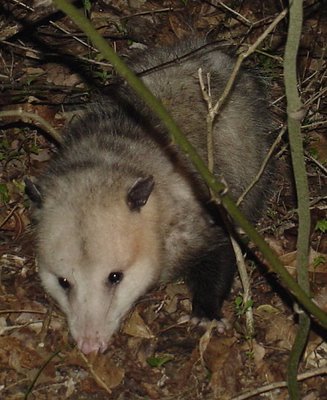
Just on the other side of the tree line we found a possum. A.k.a. a Virginia Opossum (Didelphis virginiana), a.k.a. North America's only native marsupial.

He didn't roll over and play dead, but he sure did a good job at playing frozen.

Friday, April 2, 2010

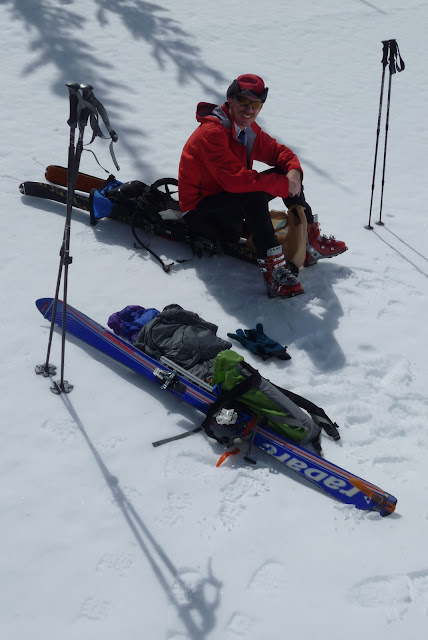
Skiing and Alpinism?

I have a buddy who found climbing late in life. He really enjoys climbing and doing moderate classics here in the Cascades. With easy access to the volcano's locally one of the side sports seemed really fun to Joe, which was, alpine touring. Joe took a buddy's advice to heart, which was, "learn to ski first or you'll hate it". Good advice I think to a beginning climber who had never skied.


So Joe has spent the last four winters not only learning how to ski but becoming and PSIA instructor while he was at it. Last week was his first day out on AT gear. The question now is will he continue?


One of my most fond memories in the mountains was cutting under the ski area boundary rope late one spring just before the area closed for the season. Skiing was just skiing back then. No AT gear. Cross country gear was skinny stuff done in running shoes for the flats. But I do remember the amazing freedom I felt being able to go "just anywhere" on the hard pack spring corn. We only did a couple of runs that day but they are still some of the best skiing I can remember today.


That kind of spring skiing lead to a lot of hiking up hill carrying our skis and ski boots over the next decades. The original goal in our little group was to ski every month of the year. Not sure if we ever managed that. Although I have now by traveling to the southern hemisphere. But that would have been considered cheating by our old standards.


late May '73


Classic early '70s ski gear and attire!


Late spring skiing in the Pacific Northwest generally starts on Mt Hood because they had/have a summer ski program. But if you were willing to hike, Mt St. Helens (pre-crater) , Mt Rainier, Mt Baker and Shasta were all easy goals. So I was always a skier, who slowly became a climber because what I really wanted to do was ski.


I have the idea that the best alpine climbers are generally good skiers. Steep snow and weird conditions don't phase them.If you ski and climb you look at the conditions and the steepness of a slope differently. Knowing what conditions you can get stopped on if you fall and what you can't is always a good thing. Falling whilesnow climbing is likely a unusual situation. Falling on a pair of skis may not be.


Everything that applies to skiing applies to alpine climbing. It is gear intensive. The very best gear these days is super light and will allow you to do things much easier and much faster with less energy output. I admit to a bit of bias here but ifyou want to see how someone climbs, watchhow they ski. Or ifyou are forced to playwithone, watch howtheyboard;-)


The final gut check is are they willing to hike for turns in the spring and summer? If so you might well have a budding Alpinist! Make them break trail a season or twobefore you commit though. More if they ride goofy foot instead of ski. ;-)

Some sports never change. The players obviously do.At least we don't have to carry the boots now. Some how it isstill the extra baggage that seemsan issue.late May '11It is always steeper than it looks!


Joe likely questioning his own sanity a few hours before his first AT turns :)


Sunday, March 28, 2010

Happy Birthday to Aric and Me!

Today was the 12th anniversary of my 30th birthday. And it was Aric's 19th birthday. So we put on our party hats and went and had some family fun. The guys went hiking again this morning. I was going to go, but my best friend saved me. (thanks again!) So I slept in and read books. Heavenly!


After they got back, we went to lunch. Then we all played laser tag. We had so much fun. It made for a great birthday. I got awesome gifts. Nathan got me just what I asked for. Diana picked some really touchingly awesome gifts. I had my birthday buddy here for the day.


I'm a happy girl.


Happy Birthday, Aric. I still remember the very first moment that I laid eyes on you. It was love at first sight and has been love ever since. You were a joy to me when a young child and I enjoy the young man you are now. You are one of the coolest and most interesting people I know. I hope the day was great for you too, Butter Bear!


Living the life surrounded by love in Tennessee!

Positively Biketastic

Mo and Pinky

When I look back at (I know it's been a while, but I needed time to take it all in!) I remember it as the year when I started to notice a lot of positive changes in the cycling world around me. Positive changes not only in the widening selection of transport bikes available in local shops and not only in the public perception of bicycling, but also in the increasing amount of rapport, cooperation and even overlap between different "camps" of bicyclists. And I think this latter point is just as important as the others. We cyclists can be tribal and divisive; we can be each other's harshest, cruelest critics. But if we insist on identifying within rigid parameters and lashing out against each other's choice of bike, attire, and riding style, how can we hope for positive changes for cyclists as a group?


When my cycling club, the Ride Studio Cafe, began to blur the lines between the randonneuring and racing cultures, I remember it felt as if a paradigm shift was taking place. They threw a big party, where cyclists of different stripes interacted with each other with a degree of enthusiasm that showed a genuine eagerness. Dynamo lighting, racks, and wool were discussed. Unexpected common interests were found. It was truly an exciting thing to be witnessing.


At this same party, I finally met Maureen Bruno Roy, a Massachusetts-based professional cyclocross racer. In her off time Mo leads a regular life, and part of that regular life involves riding her pink mixte for transportation. For me, seeing Mo so happy and casual on her city bike was an encouraging moment: I had not encountered an athlete-cyclist outside of Europe before who saw value and usefulness in such bicycles. But to Mo the value is pretty clear, and she credits her attitude to her time racing in Belgium. "There were these Dutch bikes, and I rode them to get around when I wasn't racing; it was great!"


Around the same time, a local man named Jeff Palter got himself a Brompton folding bike and began commuting on it, posting excitedlyon Twitterabout how much he enjoyed that. If you're outside New England that name might not mean anything to you, but Mr. Palter happens to be the CEO of the Northeast Velodrome and theowner of Cycle Loft -one of the biggest roadie shops around. CycleLoft is also the main sponsor ofthe Northeast Bicycle Club - the largest local racing club and the very club that offers the "infamous" paceline ridesthat so divided my readership two summers ago. Until recently, it would have been difficult to imagine anyone associated with this camp entertaining the idea of riding around on anything but a racing bike with a backpack. I was more than a little surprised when Jeff approached me about sponsorship, explaining that CycleLoft was expanding into the city bike market.


"Looks like the war is over," said a local cyclist when I shared this news with her. I guess sometimes, with all the insults flung about, it can indeed feel like a war - especially when some are described as "riding tanks" and others as being "weekend warriors." With a chuckle, I pictured an army of speeding Cervelos clashing with an army of menacingly rolling Workcycles (incidentally - a Dutch bike company founded by an American, who got his start at Fat City).


Some time in December, I was approached by Bicycling Magazine and invited to write a weekly online column about "city bikes and gear." I was initially skeptical about what they had in mind, but it seemed pretty straightforward: They wanted to expand their coverage beyond racing, to encourage people to commute by bike, introducing them to a variety of bikes and accessories for the purpose.I agreed to writethe column. It's a short-term contract and I may not be the one doing it in the long run, but I hope to give it a running start. Or rather, a re-start: Historically, such coverage is not new for Bicycling. A 1978 copyI found of the magazine includes articles such as "Choosing a Three-Speed Commuting Bike"and "Road Test: the Bickerton Folding Bicycle."These things are cyclical. Hopefully the current cycle, with its interest in transportation and city bikes, will be around for a while.


A few days ago I read a story in the New York Times about a man who, a couple of times a week, commutes from the suburbs outside New York City to his office in Manhattan on his racing bike. It's a 40 mile ride and he uses the milage for training. He does it year round, sometimes in snow. I thought it was a cool story, especially after the cyclist himself provided additional details on Velocipede Salon. Then today I read astory in Atlantic Citiesin response to it, about ordinary New Yorkers commuting. The author mentions that some readers criticised the NYT piece for "alienating [ordinary people] who might want to ride to work," but I am glad the author herself did not go that route. Instead she gave examples of some interesting New Yorkers who rideand urged cyclists to unite in promoting their shared interests.


For those of us who have been cycling in major North American cities over the past few years, it is hard not to notice that things are changing. Now more than ever, I feel there is room for everyone who loves to be on a bike to promote their style of riding without criticising others in the process. Whether 4 miles or 40, whether in a business suit or a skin suit, whether on a cheap or expensive bike, bottom line is: It's all positively biketastic. The more we understand that, the better off we will be.

Saturday, March 27, 2010

A second opinion on the Scarpa Rebel Ultra


Patrick in his new Ultras.

Photo courtesy of P.J. Cooke


a guest blog by Patrick Walsh


As one would imagine, I was very very excited when I found out I
was going to own these boots. I had my reservations purchasing them
sight-unseen, not knowing if they would be the right size and/or fit my feet
properly. I figured worst case the boots should be pretty easy to re-sell if
nothing else.


My first reaction, and that of most to the Rebel Ultra, has been
“what are those, can I see them?” This is followed by “holy crap those are
freakish light.” They are more akin to a sneaker than an ice boot, and often
the next questions are “what size are they? Can I try them on!?” This initial
excitement is soon followed by “but are they warm enough?”


At this point i have spent twelve days climbing in these boots.
I was fortunate enough to receive them just before an end of season trip to the
Canadian Rockies. I have now spent eleven back-to-back days and one single
day on the east coast in these boots. Although this is not a long time to
have spent with a boot, I feel it has been enough time to offer some real
feedback having spent the better part of two weeks in them day in and day out.


I guess first we should talk about fit. I have what had been
described as a fairly low volume foot with a high arch. My feet measure US 11.5
left and 12 right. The first thing I did was toss the factory insoles and throw
the gamut of off the shelf offerings at the boots in an attempt to get the
perfect fit. In doing so I soon came to understand that these boots are not
your average ice boot, and that bit of toe wiggling room one usually looks for
in a attempt to stay warm and ward off black toe nails is not what this boot
wants to do. This boot wants to fit more like a rock shoe (think "all day
trad shoe") resulting in a boot that feels like a warm blanket but
performs like tightly fitted sport climbing shoe. I went back and forth with
insole/sock combos searching mostly for the ideal fit regarding volume. I kept
coming back to a fit that allowed me to just barely stuff my feet into the
boots without my toes bashing off the ends or cutting off my circulation, thus
leaving little need to crank down on the laces to keep my foot in place. Fit
this way, the boots offered an amazing combination of support and dexterity,
all the while feeling much more like a overbuilt running sneaker than an
uber-light ice boot of any sort. With so little to the upper of this boot, it
really needs to be fit this way in order to offer the support ones desires in
an ice boot. Had I fit the boots with room to wiggle my toes and cold weather
circulation in mind, the boots would begin to feel a bit sloppy and lack the
support I would want in a boot I planned on climbing ice in. Fit as I had them,
the boots offer the perfect combo of support and all day comfort and
performance.


My first impression of this boot was that it was a niche item. I
figured it would be one more tool in my quiver of gear probably reserved only
for warm and or fast and light days on moderate ice in moderate conditions.
Having now done everything from long alpine days on both hard and easy terrain
to a few short days spent ice cragging and even some mixed climbing in both
warm and cold weather, I have to say these are a do everything boot and a does
everything well boot. I would go as far as saying these are a do everything and
does everything better boot. Yes on a couple cold days high on a route with
wind whipping my feet got cold. But so did both of my partners’ feet in Nepals
and Baturas. Add to that the fact that I fit them with a lightweight Smartwool
PHD ski sock more akin to a cycling sock than a wool winter sock of yesteryear
and I think, although far from a warm boot, the boots are pretty darn warm. On
a coupe of high-teens to mid-twenties Fahrenheit days, my feet felt downright
warm. These boots both approach and climb so well that even days i expect to be
cold I still choose to wear them because they just climb that much better than
any other boot I have worn, and I have worn them all. I simply no longer want
to wear any other boot as my feet just love climbing in this boot.


In summary, this boot is crazy crazy light and built incredibly well
regarding craftsmanship and materials! The boot makes me feel more like a
spider monkey climbing ice simply on his way home rather than a giant ape
clumsily making his way up the Empire State building only to be shot down by fighter
planes in a attempt at freedom. For me at least this boot is a game changer and
one I might go as far as saying you will have to "pry from my cold dead
hands."


more feedback via previous emails:


On New England Ice?

"Boots are great! I can climb anything in them. Meaning they climb hard ice
just fine if not better than my other boots. Not sure if it is in my head but I
suspect a little of both. They might be a 1/2 size small but only cuz I have
had to run my high volume custom orthotics in them.

In all reality I am pretty sure these boots made me a better climber for
real. I pretty much have stoppedkicking as I can just place my feet on the
smallest of features. What once felt like a tiny ledge now feels like a
giant shelf.I am in love!! They will be cold on cold cold days but it is
clear this is not a cold weather boot. Still though it will be very
very hard to ever want to climb in anything elseever!"


Two weeks later:

"So we had a great first trip to the Canadian Rockies. We ended up
getting out 11 daysstraight.
The boots rocked. I brought my Phantom Guides and never once wore
them. I have only great things to say about the Rebels."


The original Cold Thistle review is here:

http://coldthistle.blogspot.com//02/the-scarpa-rebels-part-one-ultra.html

Three O'Clock Rock Total Soul ..

Steve and I finally coordinated to get some climbing done. The goal was to head out to Darrington and get in a slabtastic time on the nice granite. We talked Sunday night and decided that our second attempt on Dreamer could wait, and we would head to 3 O' Clock Rock to see if we could accomplish multiple routes. We were headed there with the intent of climbing Total Soul (III, 5.10b?) and Silent Running (II, 5.9+?).

We got a late start and arrived at the trail head with no time pieces. We made quick time up the trail and stopped briefly to marvel at some cut tree trunks and a still standing western red cedar that had a 10'+ diameter at the base. Once at the base of the slabs, we made our way to the Total Soul route.

(Photo by Steve Machuga)

As we geared up, we discussed lead options, and I told Steve it didn't matter, I'd have to lead a 5.10 pitch no matter how we split them. So I told him to combine the first two pitches and give me the lead on the third pitch (a 5.7) so that could be my warm up lead. (Using the "Weekend Rock" topos.)

Looking down from two pitches up. (Photo by Steve Machuga)

Apparently I did need the warm up because after struggling to overcome one of the overlaps on the lower 5.9 section, I pulled on the draw to get over it. My lead went smoothly and soon Steve was leading the fourth pitch where the difficulty started to increase.

Starting the third pitch (Photo by Steve Machuga)

This was probably the hottest time on the slab as well. The sun was hitting us directly and we were lower and there was less of a breeze. The fourth pitch was some climbing that followed a quartz dike up with a minor crack system. For whatever reason, it was really hard on the feet and both of us had painful feet from that pitch on. (My feet didn't fully recover until getting a night of sleep.) To add insult to injury, the belay at the top of the pitch was an uncomfortable hanging belay. Fortunately for me, I was moving on to the next lead. Unfortunately, that meant not resting my feet or toes for the 5.10 pitch.

The next pitch starts interestingly enough with a few moves up an overlap to a branch pull and onto some ledges. From the ledges there are two variations; a line of bolts on the left (5.10b) or some on the right (5.10d.) The right looked easier at first, but then looked to be featureless steep slab. After contemplating the right, I choose the left line. I was able to clip the bolt and was attempting to move out left to start up, but couldn't maintain traction with my left foot. After a few balks, I went for it and slipped and fell. (I was at the bolt, so not really a lead climb.) I grabbed the draw to get back on, and then was able to climb through this crux cleanly to a small flake where the going got a bit easier. The pitch finished moving right again, so I experienced a bit of rope drag as I had not anticipated that directional change. After the move right, I went up through a bush to the next belay. (Looking at the Nelson book this morning, he has the ledge labeled "ant farm ledge" which would explain why I had ants crawling up my legs for the duration of this belay.)

Steve leading the second 5.10 pitch

I brought Steve up where he rested his feet on the nice ledge and cursed his luck for having drawn the hanging belays. This would also be the point we were both ran out of water. (Did I mention it was hot? On the drive home, the outside temp was hovering around 90°F. We did have more water waiting for us at the base of the climb though.)

After a short rest, Steve headed out on another challenging pitch. It started out easy enough following some features up to some overlaps. After one overlap the crux moves came climbing on top of a left facing shallow dihedral. Steve paused for a while before finally working out the moves. I kept a keen eye on him and was quick to arrest a fall should he have one. He clipped the second bolt and kept moving. Unbeknown to me, it somehow became unclipped and he used it to clip the third bolt on this steep smooth slab. When I arrived at these moves it took a bit of time to move off a small ledge on the first moves. I could see the minor bulges in the slab on where I wanted to put my feet, but the first right foot felt insecure. After finally deciding on a feature I moved up, only to slip off onto the ledge. Another attempt and I nailed it, keeping my upward progress going as the slab was thin and the climbing uncomfortable on my feet. I arrived at the next hanging belay panting and in considerable foot pain. Rather than stop at the uncomfortable belay, we quickly changed the rack and I headed out onto easier (5.8) ground.

Surmounting the overlap (Photo by Steve Machuga)
This pitch turned out to be the most wandering of the climb and somewhat varied. There was some initial thin moves to a small ledge with a small bush on it. After traversing left on the ledge there was a large overlap to surmount. Since the overlap was large, I couldn't bring my feet too far under it to get over it, which meant a bit of a high step to make it up. After going through a bunch of options, I got my left foot as high as it could go, and then put my right foot on the lowest lip of the overlap. With some manteling, I was up and moving onto the rest of the pitch. This was also the most gear intensive pitch and I placed about three cams and one nut. (I also somehow dropped my #2 Camalot down to pitch 2, so I'll have to replace that when I get the money. Not sure how it fell, as I wasn't even going for a piece at the time.) The rest of the pitch followed some overlaps and corners up to the belay. It was markedly more dirty/mossy than the previous pitches and gave Steve and I the impression people don't always climb the last two pitches.

The final .10b "headwall"

But we did, and after I brought Steve up to the belay he set out on the last 5.10 pitch which was thin and dirty. After gaining the steep slab, there were some leftward moves to the second bolt on thin features. He moved up slowly and made it to a tree from which he brought me up. I found there to be one committing move at the leftward motion, and the rest to be easier (although sketchier due to the dirty factor) than the other 5.10 bits on the route. Once at the top, we wandered around a bit to see some views. (Not much really, it isn't a true summit after all.) We then located the rappel tree (as well as the rappel sign) and mused at the uniqueness.


(Photos by Steve Machuga)
After a rap through the trees to another tree. (A rap anchor made with nylon nautical rope and 4" stainless rap rings.) A rap from the second tree got us back to the top of the 6th pitch. From there it was a bunch of double rope rappels back to the base. (We were able to make it into the gully from the top of the second pitch.)

(Photo by Steve Machuga)
Once back at the packs we drank a lot of water and packed up. We took a short exploratory hike over to another part of the slab before heading down to the car. We arrived back at the car around 6:45pm and drove home.

Overall I was happy with this trip. I really wanted to do more climbing in Darrington and got the chance. I think my rustiness of having only climbed three times since May showed. I think I am capable of climbing that route clean and without the aid. Hopefully Steve and I will head back and climb one or more of the other routes there and perhaps I'll get a little more practice in before heading back.
Thursday, March 25, 2010

Tombstone Tuesday :: Fisher and Davis

On September 11, .. I visited the public library in Lawrence, Kansas. Though I was unable to find an obituary for Samuel Fisher – the brother of my 2nd great grandmother, Louisa (Fisher) Phend (they were children of Michael and Christenia Fisher) or for Samuel's wife Lucretia (Davis) Fisher I did locate obituaries for several of their children, which will be the subject of future posts. I also obtained directions to Colyer Cemetery where Samuel and Lucretia are buried. During a visit to the health department to get their death certificates I found out that the records are not available at the local level, they have to be obtained from the State of Kansas.

I had to backtrack south and west of Lawrence for a short distance to get to Colyer Cemetery. It is in a rather remote area which involved traveling a bit on gravel roads and by the time I got to the cemetery, the rear of the van and my bicycle (hanging off the back end of the van) were caked with dust. From the top of the hill where the cemetery sits, you can see for quite a distance. There was a farm to the northwest and another to the northeast but nothing could be seen to the south. Remote, indeed. Very pretty. And very quiet.

The road to Colyer Cemetery, Marion Township, Douglas County, Kansas. Looking to the north.

The Fisher plot, looking to the northwest. The two barrell-shaped stones are for Lucretia and Samuel.

LUCRETIA A. FISHER / BORN AUG. 23, 1845 / DIED OCT. 31, 1909

SAMUEL FISHER / 1840 – 1913 / CO. A. 9 KAS. VOL. CAV.

FOOTSTONE.
SAMUEL FISHER / CO A / 9 KANS. CAV.

A Tale of Two Pensioners chronicles the mix-up of the pension records for this Samuel Fisher and another man of the same name.

In the second photo above, there is a marker to the south of Lucretia, which I am guessing is her mother. According to her marriage record (Douglas County Marriage Book 2 Page 33 Located at the County Clerks Office in Lawrence, Kansas), Lucretia's maiden name was Davis.

See detail below.

OUR MOTHER
GLORIANNE M. / CASWELL / WIFE OF / IRVIN DAVIS
BORN JUNE 10, 1821 / AT WATERTOWN N. Y.
DIED JAN. 30, 1882 / AT LAWRENCE KAN.
ALL'S WELL