Saturday, April 19, 2014

In Case You Were Wondering...

Yes, I did find someplace cooler! When last I left you, I was sweltering in 100 degree temperatures, along with much of the Midwest and the East Coast! Thursday morning (July 21st) I continued driving through Toledo and on into “Pure Michigan” northward. At Standish (north of the “thumb”) I followed U.S. 23 along the coast of Lake Huron. It was a very nice tree-lined drive with little traffic, but views of the lake were few and far-between. Of course, I could have stopped at one of the many public access areas but the temperature was still near 100 degrees and I was quite comfortable in my air conditioned van!


The temperature did drop the further north I drove but still in the 90s. Oddly enough it wasn't until I turned inland a ways that the temperature dropped into the upper 80s. I spent the night at very pleasant State Park at Onaway on the shores of Black Lake near the upper tip of the Lower Peninsula. The temperature actually got into the 70s overnight. Upper 70s but 70s nevertheless!


It seems that every campground has a different atmosphere to it. Some have open campsites with little privacy but the people seem friendlier there than at the campgrounds where the sites are more secluded. Some, by their very nature – such as those on or near lakes - tend to be noisier than others. It was tempting to spend a few days at Onaway but it was a busy place with lots of kids and dogs and was very noisy.


So on Friday morning I went in search of a more quiet, secluded place where I could simply relax and perhaps work on the research papers I had accumulated while in Ohio...


No, it's not Michigan! But thought I'd share this, which was taken about six weeks ago in the Rocky Mountains. Perhaps it will make someone feel a little cooler during this heat wave ;-)


Friday, April 18, 2014

A New Experience :: Kayaking!

Friday afternoon I took my first ride in a kayak! Wonderful. The day was cloudy and overcast but there was very little wind and the waters were calm. It was an amazing feeling gliding so easily over the surface of the water. It was quiet. The beaches were empty and no one else was around. Serene.

In Belfast Harbor. Getting ready to head out.

Looking out into the open ocean. Islands off in the distance.

Lobster trap buoys and the kayak paddle.

Two hours later, heading back towards the harbor.

Me and my cousin!

Thursday, April 17, 2014

Nick and Tonyia Visit The Villages


Nick and Tonyia came to visit Rich and Donna this weekend. We made plans to get together at our place Friday night, but ended up moving it to Saturday. Ava had fun catching up with Rich and Donna and Nick and Tonyia. Donna brought a mix, and Nathan got to work making us some yummy frozen drinks.


We visited on the lanai for a bit, until it started to rain. Nathan also made us some very yummy fajitas. Donna brought two different kinds of chips and salsa to add to the dinner. We had plenty to eat and it was nice to have a table that we all fit around.


After dinner, we got out the Phase 10 game and played that until quite late. Only half of us had played before so we played a practice hand to teach the others and then we were off and running. We were neck and neck at the end with Nick being the final winner.


This morning we met at Golden Coral and then Nick and Tonyia had to head back out. It was a great weekend that went by much too fast!


Wagon

I'm sitting on what I think is part of an old wagon for hauling out the logs that were cut in this little canyon all those years ago.

Wednesday, April 16, 2014

Flower walking

Saturday morning was sunny and warm, and we had a chance to walk around a bit before the bad weather set in.


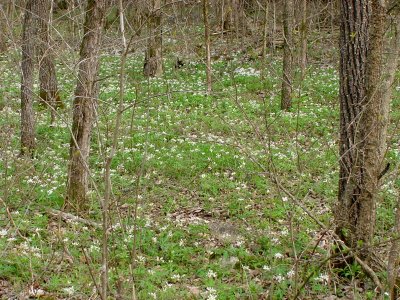
In places, the ground was a carpet of toothwort.
(Cardamine spp.)


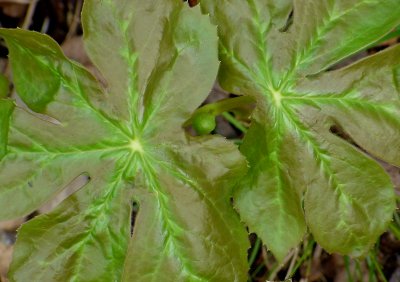
Mayapples were sprouting up everywhere. Soon the woods will be full of their little umbrellas.
(Podophyllum peltatum)


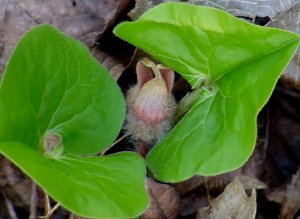
Deciduous wild ginger made its first appearance of the spring. The flower part isn't open yet.
(Asarum canadense)


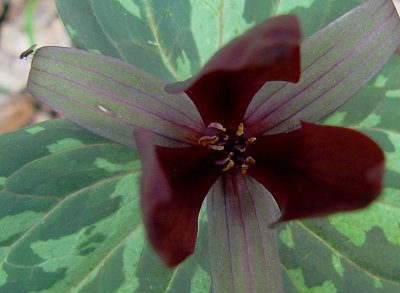
Trillium cuneatum was popping open too, so thick in some areas that you could actually smell them. The scent is meant to attract flies as pollinators, so it's not exactly pleasant. For me, latin names are best for most trilliums, since their common names seem to be used so interchangeably (wake robin, sweet betsy, toadshade, etc.).


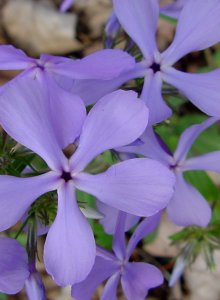
Wild Blue Phlox is just starting to appear.
(Phlox divaricata)


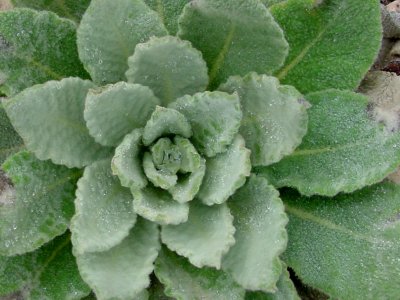
A small first year mullein plant. The story goes that if you use this for uh, wiping things in the woods, you'll regret it... It looks soft but has irritating hairs. It's an introduced plant, classified as a noxious weed, that has been in the US since the 1700s. I've read that a single plant can produce over 100,000 seeds, which can remain viable for 100 years or more.
(Verbascum thapsus)

Heavy equipment and during/after photos

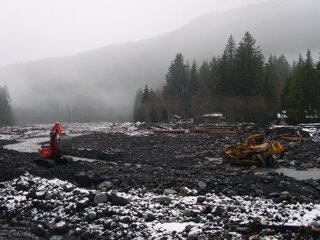
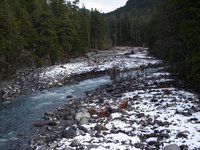
The road to Mt Rainier National Park's recovery is passing through some interesting terrain. Today, I saw a large bulldozer working in the Nisqually River. One of the vexing problems for the NPS is that rivers and streams have jumped their main channels. During a storm, riverbeds can become filled with debris, which in turn causes the river's flow to change its course. To some extent, that is why the Emergency Operations Center was threatened, and why the stream jump at Kautz Creek is causing such a repair headache. So to protect the facilities in Longmire, heavy equipment is now being used to clear the build up of rock, logs and other debris from the last rainstorm and flood.

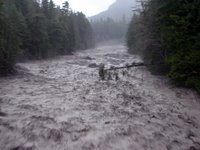
The historian in me wanted to capture a during and after view of the Nisqually River. Here is the "during" image from Monday afternoon, Nov. 6th when things really started to roll. This picture is taken from the Longmire bridge looking upstream.


And here is the "after" view, taken today Nov 17th. Note the tree that hangs over the Nisqually River in both photos, and also the color of the river.

Tuesday, April 15, 2014

Blue Ice :: Portage Glacier

A mutual decision was made to leave Denali National Park a day early, partially because the time that Sue and Fred had in Alaska was limited and, without advance reservations, we had pretty much done what we could in the park. We drove south on Wednesday (August 11th) through Anchorage and part way around Turnagain Arm to Chugach National Forest and the small town of Portage.

We found a campsite at Williwaw Campground in the National Forest then immediately drove to Portage Glacier Lake and caught the last tour boat of the day for our first close-up look of an Alaska Glacier!

In the late 1800s there were four glaciers in this area that came together. Miners and other hearty souls used the glaciers as portage routes. Portage Lake was formed about a hundred years ago when the glaciers began receding. All four glaciers still exist but three of them are called “hanging glaciers” since they have receded so far and no longer come down into the valley.

Our vessel was the 80-foot Ptarmigan, shown here coming in to shore prior to our tour.

From the visitor center, Portage Glacier is hidden behind the mountain outcropping on the right.

Portage Glacier is on the right. It is called a valley glacier since it goes all the way into the valley. It is 450 feet deep but since there is nothing to give it perspective there was no way to really judge how high it was.

Photographs certainly do not do it justice! The rocks facing us in the center are 175 feet high!

A portion of the face of the glacier.

The closest we got was 300 yards away because of the possibility of calving – where ice breaks away and drops into the water. We didn't see any calving but felt the wake of a shooter – where a piece of ice breaks off beneath the surface and pops up out of the water.

There was a Forest Ranger on board who provided some scientific information about glaciers but, honestly, I wasn't paying attention! The blue color of the ice was intense and amazing. If you want to know more about why the ice is blue, check out this Causes of Color website.

In some places the ice hangs over the surface of the water, thus the “dark line” where the ice meets the water.

To put it into perspective, the Captain showed us a photograph taken a few years ago. He let me take a picture of that photograph and it is being used with his verbal permission. The Ptarmigan (the tour boat we were on) is floating in the middle of the bay amongst smaller icebergs in the same location as we were in – 300 yards away from the face of the glacier – and the boat (the largest of the floating objects) is merely a speck in the water.